
Workshop 4: Feminism, Publishing, Futures
11 June 2025, University of Stirling, Scotland
World Making Words: Connecting women’s literary agency, activism and enterprise in South Asia: Workshop 4 on Feminism, Publishing, Futures.
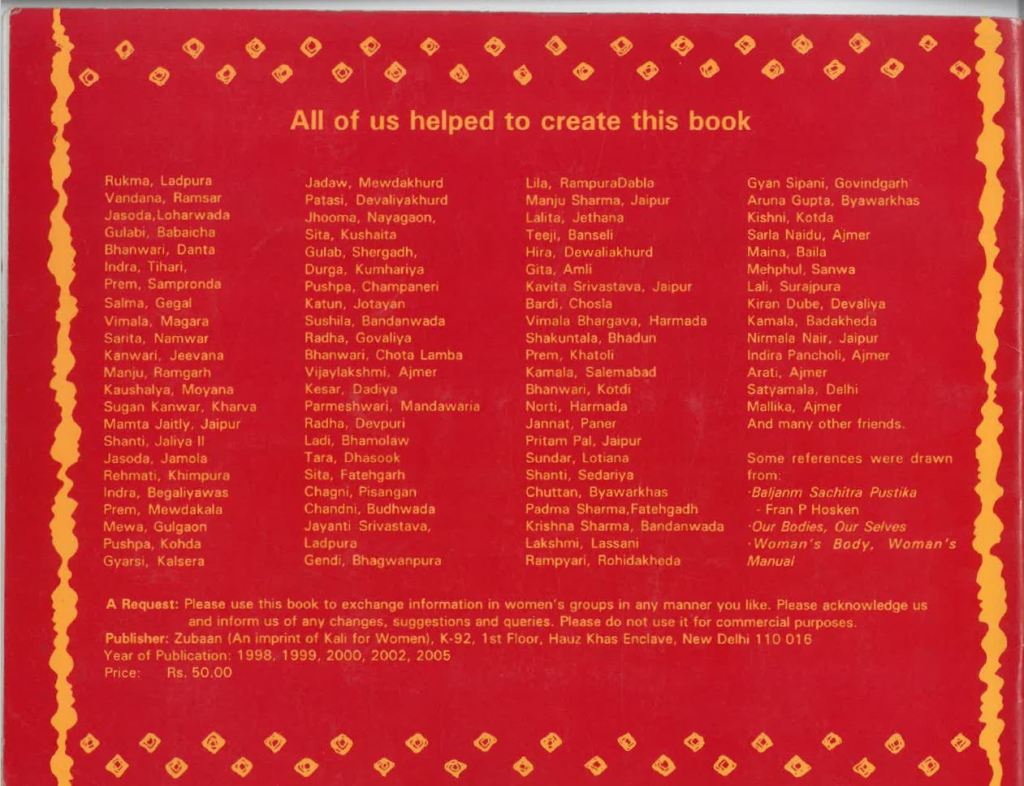
This final workshop will investigate the role of feminist writers and publishers in exploring the intersection of questions of gender with configurations of class, caste, ethnicity, religion, and gender and sexual minority, via the publication of texts depicting South Asian women’s lives and experiences. Taking Kali for Women’s publication of co-written Hindi reference book Shareer Ki Jankari(1989) as a starting point, the workshop will investigate what economic, cultural, linguistic, and technological factors have impacted the commissioning, publication, circulation, reception, reputation, and profile of such alternative forms of writing in national, regional, and global arenas. This workshop is delivered in collaboration with Professor Claire Squires (Stirling Centre for International Publishing and Communication, University of Stirling, UK).
About the event
Workshop events will take place between 9am – 5pm UK time at the Stirling Centre for International Publishing and Communication. There is also the option to join online.
To secure a place, please visit our Eventbrite page.
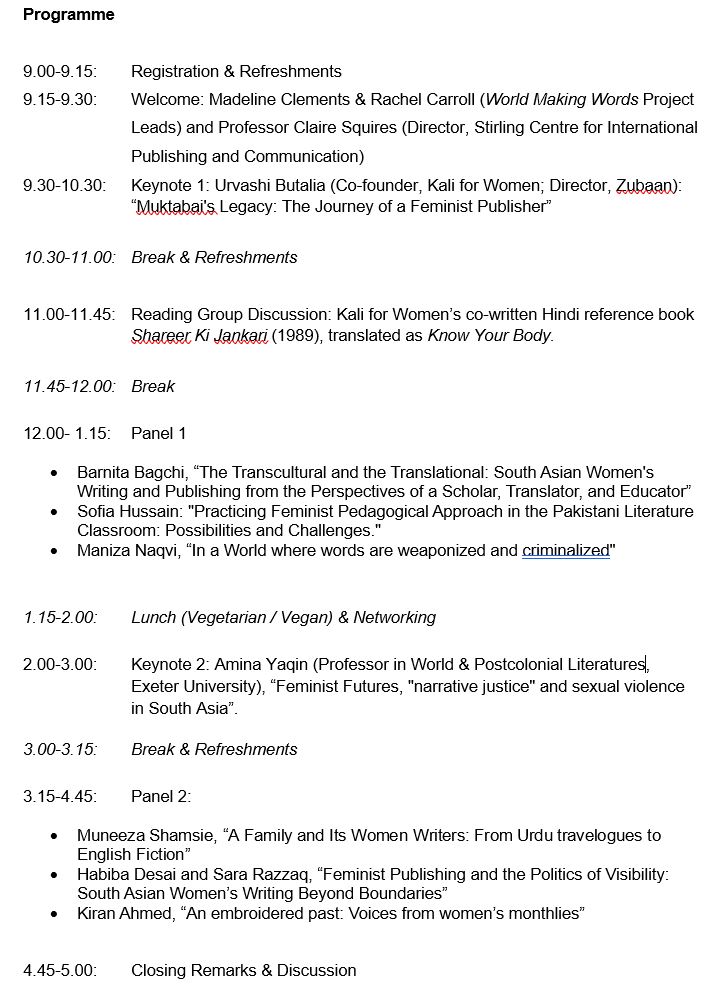
Keynotes will be presented by Urvashi Butalia (Co-founder, Kali for Women; Director, Zubaan) and Amina Yaqin (World Literature & Publishing, Exeter University).Contributors include: Kiran Ahmed (Independent Scholar, formerly of the Centre of Excellence in Gender Studies, Quaid I Azam); Barnita Bagchi (feminist advocate and translator, University of Amsterdam);Habiba Desai and Sara Razzaq (Co-Directors, Fox &Windmill); Sofia Hussain (Co-founder, Islamabad Chapter, Contemporary Women’s Writing Association); Maniza Naqvi (CEO, The Little Book Co.); Muneeza Shamsie(Independent Scholar, Karachi and London).
Programme
Speaker Profiles:
Kiran Ahmed
Kiran Ahmed is the former head of Gender Studies at Quaid-i-Azam University and the author of Stories with Oil Stains: The World of Women Digest Writers in Pakistan (OUP 2020). She holds a PhD from the University of Texas at Austin, and masters’ degrees in International Relations, Philosophy and Anthropology from Pakistan, Canada and the US respectively.
Barnita Bagchi
Barnita Bagchi is Chair and Professor of World Literatures: English at the University of Amsterdam in the Netherlands. She has translated fiction by e.g. Jyotirmoyee Devi and Selina Hossain; next year, her translations of some short stories by Rabindranath Tagore will appear in an Oxford World’s Classics selection. Her book-length publications include Pliable Pupils and Sufficient Self-Directors: Narratives of Female Education by Five British Women Writers, 1778-1814 (New Delhi: Tulika: 2004), a part-translation with introduction, Sultana’s Dream and Padmarag: Two Feminist Utopias, by Rokeya Sakhawat Hossain (New Delhi: Penguin Classics, 2005; renewed Penguin USA edition, 2022), and the edited volumes, The Politics of the (Im)possible: Utopia and Dystopia Reconsidered (SAGE, 2012; republished by Atlantic, 2024), and Urban Utopias: Memory, Rights, and Speculation (Jadavpur University Press, open access, 2020). She has published widely, notably on utopia and dystopia, and women’s writing in South Asia and Britain, 1770s to contemporary times.
Urvashi Butalia
Urvashi Butalia is co-founder of India’s first feminist publishing house, Kali for Women (set up in 1984) and now runs Zubaan, another feminist imprint that was set up when Kali shut down in 2003. She has a long involvement in the women’s movement in India and is an independent researcher and writer who writes and publishes widely on a range of issues to do with gender. Among her best known publications are Speaking Peace: Women’s Voices from Kashmir (edited), Partition: The Long Shadow (edited) and the award-winning oral history of Partition: The Other Side of Silence: Voices from the Partition of India (winner of the Oral History Book Association Award 2001 and the Nikkei Asia Award for Culture 2003). She is currently working on the life of a hijra friend of hers, Mona Ahmed. She is a recipient of several awards including the French Chevalier des Lettres et des Artes, the Nikkei Asia Award for Culture, the Goethe Medaille and the Padmashri.
Habiba Desai & Sara Razzaq
Habiba is the publishing and partnerships director at Fox & Windmill. Her main role is to oversee the publishing process of the manuscripts, from editing, typesetting and to print. When she isn’t working, you can find her taking photographs, reading Persuasion for the umpteenth time or walking in the wilds. Sara is the submissions director at Fox & Windmill. She produces the seasonal podcast, works with our writers and manages the finance. When she isn’t working, you can find her reading contemporary literature, drinking tea and enjoying Pride & Prejudice.
Sofia Hussain
Dr. Sofia Hussain is an Assistant Professor and In-Charge of Academic Affairs in the Department of English at the International Islamic University, Islamabad (IIUI). She is also a founding member of the Critical Thinking Forum (CTF) and has served as a Research Assistant and Co-Lead on various international projects. Dr. Hussain co-founded the Islamabad Chapter of the Contemporary Women’s Writing Association (CWWA), UK—the first chapter of CWWA established outside the United Kingdom. She has co-edited the volume Muslim Women Writers of the Subcontinent: 1880–1960, and is one of the editors of the online literary magazine Gentle Visitations. Her research interests include Feminist Literary Studies, Critical and Feminist Pedagogies, and South Asian Literature.
Maniza Naqvi
Maniza Naqvi is a novelist and short story writer. Her five published novels are: Mass Transit, On Air, Stay with Me, A Matter of Detail and The Inn. Sarajevo Saturdays is a collection of her short stories and poems. Her book A Guest in the House is a memoir which chronicles her time at the Pioneer Book House, Karachi and provides a lens into the history of the city. Her storytelling of this memoir was on The Moth Radio Hour. Her short stories are included in several anthologies. She is the Founder and CEO of The Little Book Company, a start-up e-book digital platform for publishers, authors, and booksellers. She has 30 years of experience in Social Safety Nets and Post Conflict Jobs and Community Programs Development.
Muneeza Shamsie
Muneeza Shamsie (Sitara-e-Imtiaz) is the author of Hybrid Tapestries: The Development of Pakistani Literature in English (2017) and editor of four anthologies including In the New Century: An Anthology of Pakistani Literature in English (2024); her third anthology And The World Changed: Contemporary Stories by Pakistan Women received the 2009 Gold IPPY and 2008 Bronze Foreword Awards in the US. She is Area Editor for the online Literary Encyclopedia, Bibliographic Representative (Pakistan) for Literature, Critique and Empire Today and is on the Advisory Boards of The Journal of Postcolonial Writing, the DSC Prize for South Asian Literature, and the International Centre for Pakistani Writing in English. She has served on various literary juries including the DSC Prize, The Patras Bokhari Award and the Karachi Literature Festival-Getz Pharma prize and was regional chair (Eurasia) of the Commonwealth Writers Prize 2009-2010. She lives in Karachi and contributes to the Pakistani press.
Amina Yaqin
Amina is the author of Gender, Sexuality and Feminism in Pakistani Urdu writing (2022), which plots a genealogy of gender in Urdu literary culture and the legacy of Urdu feminist poets in the twentieth century. Another major publication is Framing Muslims: stereotyping and representation after 9/11 (co-authored with Peter Morey) (2011), which explores the racial stereotyping and self-stereotyping of Muslims in media narratives in North America and the UK. She was Co-Investigator (with Peter Morey) on two funded research projects Framing Muslims (AHRC international Research Network) and Muslims Trust and Cultural Dialogue (RCUK). She is currently Co-I on the AHRC funded project Empathy, Narrative and Cultural Values. She is also a co-founding co-editor of the interdisciplinary journal Critical Pakistan Studies published by Cambridge University Press and co-founding co-editor of Global Textualities: Multicultural and Transcultural Narratives published by Manchester University Press.
 World Making Words